
Territorial attractiveness is now a major concern for hospitals, but even more so for those located in Medically Underserved Areas (MUA).
The shortage of healthcare personnel is no longer a temporary crisis ; it is a structural issue that regions must deal with. But in MUA or areas with severe shortages, financial incentives are no longer enough. Relocation bonuses are sometimes attractive, but rarely attract long-term employees.
According to a study from the EHESP, the real challenge of regional attractiveness is played out well before installation: it is played out during the internship.
However, for a nursing student, an internship in a MUA is rarely a first choice. In fact, it is very often the last choice.
There are many reasons for this, but it is often stereotypes that put off future interns.
- Lack of supervisory staff
- Dilapidated hospital complexes
- Obsolete equipment
- Fear of isolation
If the internship experience is poorly managed—and therefore poorly received—it will confirm these prejudices. If, on the contrary, it is smooth and rewarding, it could break down stereotypes and create a bond.
Internships are therefore an important issue, as they determine both access to the profession and access to healthcare.
The issue of popular internship placements
It is a fact that students are less attracted to less densely populated areas. When it comes to choosing an internship location, the majority of them opt for hospitals in city centers, which are known to be better equipped and more welcoming.
Although this choice may seem insignificant, it has a significant impact on the internships quality. Indeed, this high demand for large hospitals creates an overload in the care units concerned. This has a direct impact on the experience of interns.
If healthcare staff are overworked, they are less available to supervise students, who may then feel neglected and useless. Conversely, they may also be exploited to compensate for this overload. In both cases, this leads to a negative internship experience, which can have long-term consequences. Quitting the internship, quitting the studies and, as a result, a shortage of healthcare workers, leading to a decline in the care quality.
Meanwhile, MUA, which are able to offer significant capacity and privileged supervision, are less sought after by interns and their training institutions.
This creates learning inequalities that impact students in the short term, thereby permanently undermining access to care for future patients.
A lack of structural tools
However, the problem with the territorial attractiveness of MUA does not stem from healthcare trainees shunning more remote facilities in favor of university hospitals, nor from the latter scooping up all available students, but rather from a lack of tools and visibility regarding unfilled internship spots.
In most cases, hospitals are unable to quantify the number of students interning in their facilities, let alone provide accurate forecasts of their future capacity.
This creates uncertainty for training institutes. Which tend to contact the same facilities over and over again to place their students.
Territorial visibility : the key to a balanced distribution of internships
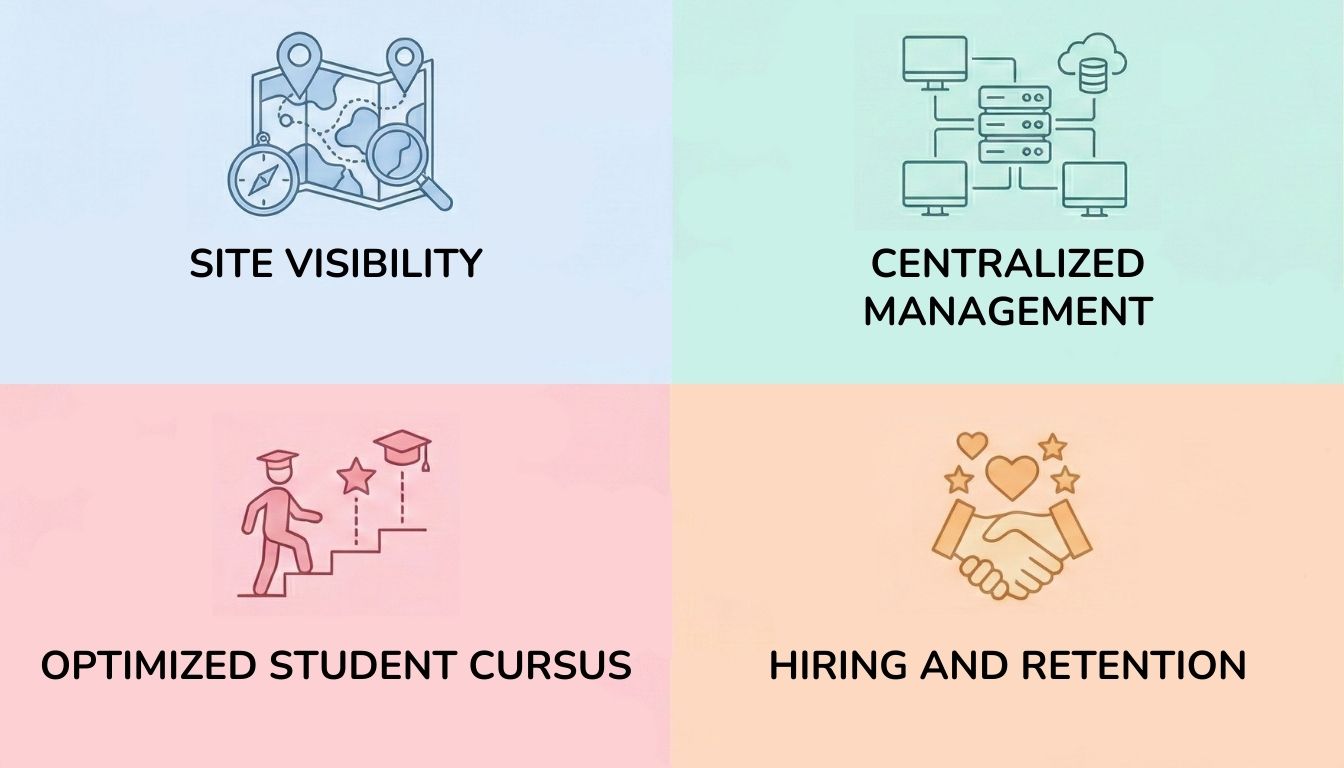
Optimizing the interns reception depends on a clear understanding of the capacities available in the setting. Regardless of the level (unit, department, institution, regional hospital group, or territory), having an accurate map of vacant and filled positions is essential to guaranteeing students high-quality supervision.
With this in mind, we have developed regional management features in Interneo. Thanks to its centralized management, our tool allows you to control this distribution on a regional scale. By better considering the placement of interns, we avoid overloading certain departments while supporting those that are understaffed.
In addition, the tool provides a complete history of students’ career paths. This allows you to optimize future choices and build fair and diverse internship paths.
Encouraging practice in MUA through well-structured and rewarding internships remains the most powerful lever for changing the perception of future professionals, retaining them in the long term, and boosting the attractiveness of the region.
Conclusion : don’t suffer from shortages anymore, take control of your attractiveness
Settlement bonuses and short-lived financial incentives will not be enough to save underpopulated areas. Retaining future healthcare professionals depends crucially on their initial experiences in the setting.
With Interneo, you can take back control of the distribution of internships across your entire territory. This puts peripheral hospitals back in the spotlight.
By exposing students to the richness of these healthcare pathways, you will be able to dispel the preconceptions that still penalize the territorial attractiveness of MUA. By guaranteeing a high-quality welcome in these fragile territories, you enhance the value of your structures and maximize your chances of converting these students into long-term employees.
Ready to rethink your territorial strategy ?
Contact us to discuss the realities of your hospital group.